
Standfirst: Ozempic, Wegovy, Mounjaro and related medicines are usually discussed as a healthcare story. For packaging and FMCG companies, they may also be an early signal of a new consumer economy built around smaller appetites, smaller portions and more deliberate purchasing.
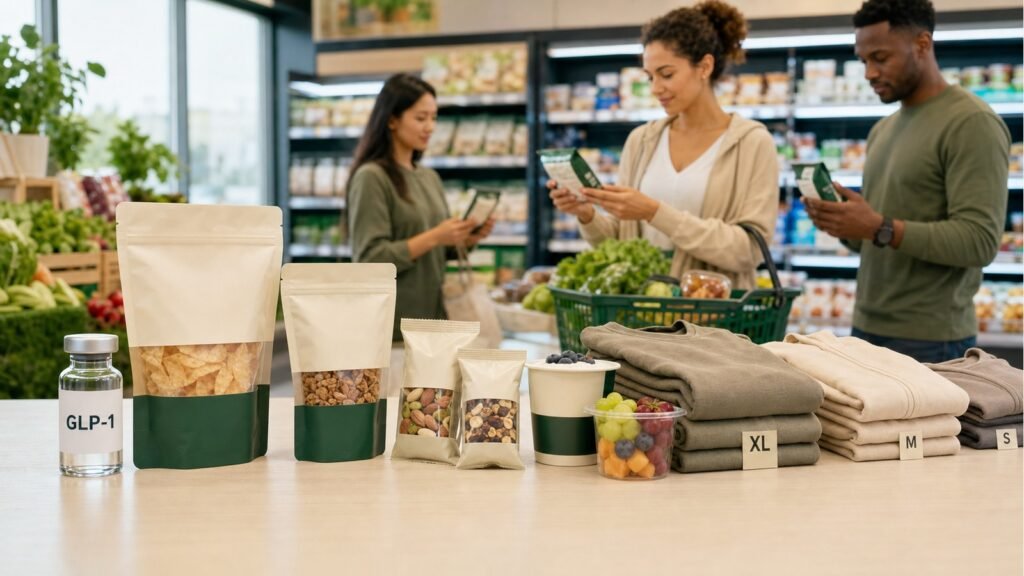
For decades, the food and packaging industries have been designed around a fairly stable assumption: people want convenience, taste, value and enough quantity to feel satisfied. Brands fought for visibility. Retailers built impulse zones. Manufacturers optimized high-volume formats. Packaging was asked to protect, display, portion and promote products in a world where appetite was broadly predictable.
GLP-1 medicines challenge that assumption. Drugs such as Ozempic, Wegovy, Mounjaro and Zepbound were developed for diabetes, obesity and related metabolic conditions, but their commercial impact is beginning to travel beyond healthcare. By reducing appetite, slowing digestion and changing food reward for many users, they are also changing what people buy, how much they eat and which categories feel attractive.
This is still an emerging market effect, and it would be wrong to overstate it. Snacks, confectionery, soft drinks, fast food and indulgence will not disappear. But the early evidence is strong enough for packaging leaders to ask a more useful question: if even a meaningful minority of consumers begin eating less, craving less and shopping more deliberately, what happens to pack size, product mix, shelf economics and supply chains?
Why this is bigger than a diet trend
The food industry has seen many diet cycles. Low fat, low carb, sugar-free, keto, plant-based and high-protein trends have all shaped product launches. GLP-1s are different because they do not rely only on willpower or identity. They can alter hunger and satiety directly for many users. That makes the effect more structural than a typical consumer fad.
Public health research has long argued that modern food systems create a “junk food cycle”: energy-dense products are cheap to produce, profitable to market and easy to overconsume. The UK National Food Strategy for England, published by government in 2021, framed the problem as a full food-chain issue, covering production, marketing, processing, sale, purchase and consumer behaviour. GLP-1 adoption does not solve that food-system problem by itself, but it introduces a new pressure point: what happens when the appetite loop is medically interrupted?
Recent adoption numbers show why this is becoming commercially relevant. KFF reported in late 2025 that 18% of US adults said they had ever used a GLP-1 drug and 12% said they were current users. In the UK, the Food Foundation reported in May 2026 that nearly 7% of the population had already used GLP-1 drugs, while a further 8% had considered or were considering them. Worldpanel by Numerator reported that current use in Great Britain rose from 2.3% in March 2024 to 4.1% in 2025.
That is not universal adoption. It is also not niche adoption. It is enough to begin changing baskets, eating occasions, clinic demand, cold-chain pharmaceutical logistics and the way adjacent sectors think about body size and consumption.
The oral GLP-1 inflection
The next inflection is route of administration. Injectable drugs can still feel medical, expensive and inconvenient. Oral GLP-1s lower that psychological barrier. In September 2025, the phase 3 ATTAIN-1 trial of oral orforglipron was published in the New England Journal of Medicine and reported significant weight loss and improved cardiometabolic risk factors versus placebo. The same month, OASIS-4 results showed once-daily oral semaglutide 25 mg produced significant weight loss versus placebo.
For packaging and FMCG companies, pills matter because they can shift adoption from a clinic-led injection market toward a more ordinary chronic-treatment market. If access broadens and prices fall over time, the effect on food demand is less likely to be a short cycle and more likely to become a planning assumption.
The grocery basket is already moving
The clearest commercial evidence comes from grocery data. A 2026 Journal of Marketing Research study found that US households with at least one GLP-1 user reduced grocery spending by 5.3% within six months of adoption. The decline was sharper among higher-income households, at 8.2%. The largest category declines were in calorie-dense, processed products: chips and savoury snacks fell 10.1%, sweet bakery fell 8.8%, and cookies fell 6.5%.
The same study found an 8.0% decline in spending at fast-food chains, coffee shops and limited-service restaurants. It also found that some categories moved in the other direction, with yogurt showing the largest positive movement among categories with directional gains, alongside nutrition bars, fresh fruit and meat snacks.
A separate JAMA Network Open study using Danish supermarket receipt data found that after GLP-1 initiation, purchases shifted toward fewer calories, sugars, saturated fats and carbohydrates, with modestly higher protein content and a lower share of ultra-processed foods. The signal is not simply “people buy less food.” It is “people buy a different basket.”
For packaging, this distinction matters. A lower-volume consumer is not necessarily a lower-value consumer. Smaller appetites may still support premium formats, higher nutrient density, better portion control and more functional packaging. But the pack has to match the new consumption logic.
Impulse categories face the first test
The most exposed categories are those built around impulse, grazing and repeated reward. Salty snacks, confectionery, sweet bakery, ice cream, sugar-sweetened beverages, alcohol and quick-service meals all depend, in different ways, on appetite cues and convenience cues arriving at the same moment.
GLP-1s do not have to eliminate those occasions to create pressure. A 5% to 10% reduction in a high-margin, high-frequency category can matter more than a larger movement in a low-margin staple. Convenience retail is particularly exposed because profit is often concentrated in impulse-led products rather than in the full basket.
This is where packaging strategy becomes more than a design exercise. The classic snack pack often signals abundance, flavour intensity and immediate reward. In a smaller-appetite market, the winning pack may need to signal restraint, freshness, control and satisfaction in fewer bites. That points toward mini formats, credible single serves, resealable packs, multi-portion formats with clear portion breaks, stronger freshness protection and front-of-pack cues that make the product feel intentional rather than automatic.
Portion architecture becomes a boardroom issue
Portion size has always been a packaging decision, but GLP-1 adoption makes it a more strategic one. A consumer who feels full faster may reject large packs, but still pay for quality, convenience and taste. The opportunity is not simply to shrink existing products. That risks looking like shrinkflation. The opportunity is to redesign the eating occasion.
For dairy, this may mean smaller high-protein cups, better lidding, spoon-in-lid formats, multipacks and chilled packs that communicate satiety and freshness. For snacks, it may mean controlled-portion pouches with better barrier films and reseal systems. For bakery and confectionery, it may mean smaller indulgence units that feel crafted rather than reduced. For ready meals, it may mean protein-forward, smaller-format meals with packaging that supports microwave performance, portion clarity and waste reduction.
Packaging suppliers should expect more requests for smaller runs, more SKU variation, more testing of portion formats and more pressure to hold margin despite higher packaging cost per gram of product. This is not an easy shift. Smaller packs can raise material intensity, complicate line speeds and increase SKU complexity. The commercial winners will be those who make smaller formats feel valuable, not merely smaller.
What changes for the converter
The practical implication is not one universal pack. It is a shift in the format brief by category. The table below is a starting point for commercial teams, converters and packaging buyers.
| Category | Legacy pack logic | Emerging pack logic | Converter implication |
|---|---|---|---|
| Savoury snacks | Large pillow bags and sharing packs built for grazing | 25-60g single serves, portioned multipacks and resealable pouches | More short-run printed film, stronger barrier laminates, zip/reclose features and tighter SKU management |
| Confectionery | Large bars, sharing pouches and value-led countlines | Mini portions, premium small formats and giftable controlled indulgence | Higher print quality per gram, more artwork rotation and premium wraps that justify smaller unit size |
| Dairy and protein | Family tubs and basic chilled cups | High-protein single-serve cups, drinkables and spoonable snack formats | Growth in rigid PP/PET cups, foil or film lidding, shrink sleeves and chilled-chain secondary packaging |
| Beverages | Large sugary soft drinks and high-volume refreshment packs | Functional, zero-sugar, protein or hydration-led slim formats | More slim cans, PET label complexity, claim-led print and multipack carriers for smaller units |
| Frozen and ready meals | Family trays and carb-heavy value meals | Portion-controlled, protein-forward single serves | Smaller trays, lidding films, more sleeves, more variants and compliant nutrition messaging |
The product mix may change before the shelf layout does
Some categories are likely to benefit from the appetite reset. GLP-1 users often need to think about protein, fibre, hydration, micronutrients, muscle maintenance and digestive comfort because they are eating less overall. That can favour yogurt, dairy proteins, eggs, lean meats, legumes, fibre-rich foods, fruit, portioned nuts, nutrition bars and functional beverages.
This is a packaging opportunity as much as a product opportunity. Nutrient-dense products often need stronger barrier performance, chilled-chain reliability, better single-serve ergonomics and clear communication in limited label space. If consumers are eating fewer times per day, each eating occasion has to work harder. Packaging has to help the product prove its role quickly.
There is also a waste angle. Smaller appetites can create more unfinished product, particularly in large family-style packs or foodservice portions. Resealability, portion separation, freezer compatibility and durable secondary packs become practical ways to preserve value. In markets where household budgets are stretched, reducing waste may be as important as reducing calories.
Clothing is an early warning from another sector
The appetite reset is not confined to food. Apparel retailers are already seeing the operational challenge of changing body sizes. In May 2026, Axios reported that David’s Bridal had launched a fit guarantee as more customers worried about body changes before events. The company said 20% of bridal customers had shifted to shorter shopping timelines, rush orders had increased 50% over the past year, and alterations within three weeks of an event were up 8%.
That example matters for food and packaging because it shows how a health intervention can create second-order demand effects. The first effect is weight change. The second effect is uncertainty: shoppers delay purchases, retailers adjust size curves, alteration capacity becomes a bottleneck and inventory planning gets harder.
Food companies may face their own version of this. Consumers may delay bulk purchases, move away from large impulse packs, test new protein formats, buy less alcohol, or shift to smaller treats. Demand planning built on last year’s volume curves may become less reliable in categories where appetite is a major driver.
African markets should watch the signal, not copy the response
In many African markets, GLP-1 adoption will be constrained by price, healthcare access, regulation and cold-chain availability. The near-term mass-market effect will therefore be smaller than in the US or UK. But it would be a mistake to ignore the trend.
First, the Middle East and Africa GLP-1 receptor agonist market is already a measurable category: Grand View Research estimates 2025 regional revenue at USD 933.3 million and projects a 14.5% CAGR from 2026 to 2033. Second, obesity prevalence in the Gulf is high enough to make metabolic-health demand a long-term regional issue. A Gulf Economic Update using WHO data shows adult obesity rates above 30% in Kuwait, Qatar and Saudi Arabia, with female obesity rates above 40% in several GCC markets. Third, South Africa is no longer theoretical: SAHPRA has issued warnings about GLP-1 products sold through social platforms, and Reuters reported Wegovy’s 2025 South Africa launch as the product’s Africa debut.
The packaging point is that Africa and adjacent MEA markets already understand small formats. Sachets and other small packs are widely used in emerging markets because they lower the cash price of branded goods, while the global sachet packaging market is being driven by demand for affordable, convenient and single-use formats in developing economies. The opportunity is to move that infrastructure from pure affordability toward controlled portions, fortified staples, protein-rich snacks, shelf-stable dairy alternatives and waste-reducing packs.
For African packaging suppliers and food manufacturers, the opportunity is not to import every Western health trend. It is to identify where controlled portions, fortified staples, protein-rich snacks, shelf-stable dairy alternatives, responsible single-serve beverages and waste-reducing packs can meet real local needs.
What packaging leaders should do now
GLP-1s should be treated as a demand-sensing issue, not a panic issue. The practical work is to map exposure and option value.
- Map category exposure: identify products that rely on impulse, overconsumption, large portions or high-frequency snacking.
- Review pack architecture: test whether smaller, resealable or portion-separated formats can protect margin and improve relevance.
- Follow the protein and fibre shift: evaluate packaging needs for chilled protein, dairy, fortified staples, nutrition bars, fruit and controlled snacks.
- Model manufacturing friction: smaller packs and more SKUs may require different films, lidding, cartons, changeovers, minimum runs and pallet configurations.
- Watch adjacent sectors: apparel, hospitality, alcohol, convenience retail and healthcare logistics can reveal second-order effects before they appear fully in food sales.
The companies that respond best will not be the ones that declare the end of indulgence. Indulgence will remain. The better response is to build formats for a consumer who wants less volume, more control and clearer value from each eating occasion.
The packaging conclusion
GLP-1 drugs are often framed as a pharmaceutical breakthrough. They may also become a packaging inflection point. If appetite changes, then the job of packaging changes with it. The pack must help consumers buy smaller quantities without feeling penalized, consume deliberately without waste, and find products that fit a more health-aware basket.
That is why this topic deserves attention from packaging executives, not only from doctors, food marketers or investors. Appetite sits upstream of demand. When appetite changes, every product, pack and supply chain built around it has to be reconsidered.
Planning for smaller-appetite demand?
Packaging teams should review pack sizes, resealability, portion architecture and exposure to impulse-led categories before the trend is fully visible in annual sales data.
Discuss the packaging response
Selected sources: UK National Food Strategy for England; KFF Health Tracking Poll on GLP-1 use; The Food Foundation UK GLP-1 survey; Worldpanel by Numerator GLP-1 study; Journal of Marketing Research study on GLP-1 adoption and food demand; JAMA Network Open study on GLP-1 initiation and supermarket purchases; American College of Cardiology summary of ATTAIN-1 oral orforglipron data; American College of Cardiology summary of OASIS-4 oral semaglutide data; FDA approval of tirzepatide for obstructive sleep apnea in adults with obesity; American College of Cardiology summary of SELECT cardiovascular outcomes; Axios reporting on apparel fit and GLP-1-era shoppers; Grand View Research MEA GLP-1 market outlook; Grand View Research sachet packaging market outlook; Gulf Economic Update obesity data; SAHPRA warning on GLP-1 products sold through social platforms; Reuters report on Wegovy launch in South Africa.